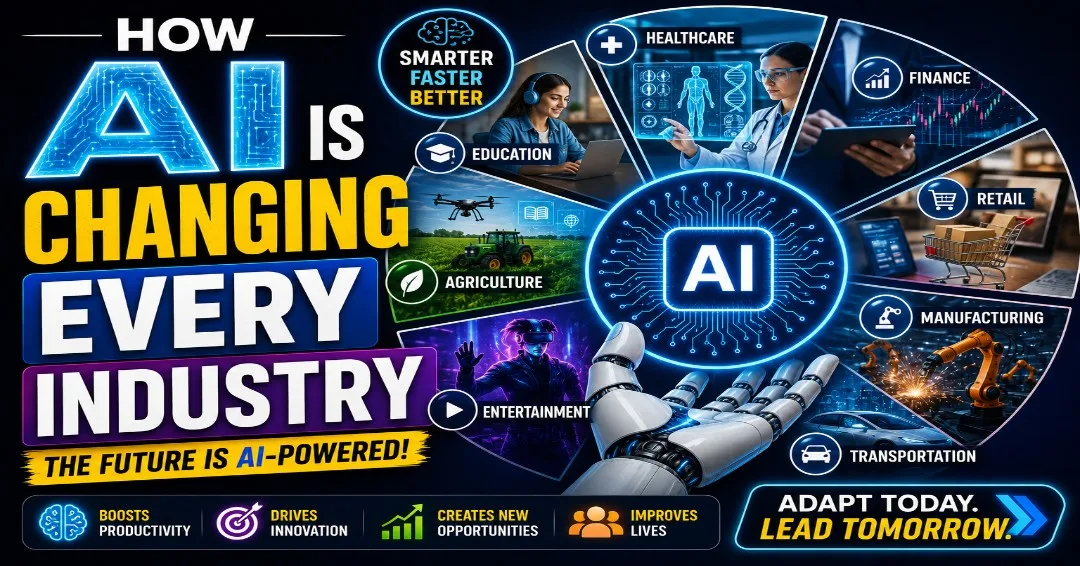
How AI Is Changing Every Industry
Join Our WhatsApp Channel for Latest UpdatesHow AI Is Changing Every Industry
For the last few years, AI has mostly lived in pilot projects — a chatbot here, a demo there, a slide in a strategy deck about "exploring generative AI." That phase is ending. Across healthcare, manufacturing, finance, retail, and government, AI is moving from something companies experiment with to something they run on. Here's what that shift actually looks like, industry by industry, and what's driving it.
The Big Shift: From Answering Questions to Taking Action
The defining change of this moment isn't a smarter chatbot — it's AI that acts. Traditional AI tools respond when you prompt them. The newer wave, generally called "agentic AI," can plan a multi-step task, execute it across several systems, and only loop in a human when something needs judgment or approval.
A simple example: instead of an AI tool just drafting an email, an agent in a procurement department can receive a request, compare supplier quotes, raise a purchase order, and update inventory — start to finish, without someone managing each step. Industry groups have called this <cite index="10-2">the biggest shift for enterprises this year, with companies already deploying agentic AI to automate processes that previously required entire teams</cite>.
This matters because it changes the unit of automation. Older software automated tasks. Agentic AI is starting to automate workflows — whole chains of decisions that used to require a person moving information from one system to another.
Healthcare: From Diagnosis to Drug Discovery
Healthcare is arguably furthest along. AI is now involved in everything from reading scans to designing new drugs to handling the administrative paperwork that quietly consumes huge chunks of every clinician's day.
On the regulatory side, <cite index="13-2">the FDA has approved more than 690 AI-enabled medical devices, spanning radiology, pathology, cardiology, and neurology, with diagnostic accuracy in many areas matching or exceeding human specialists</cite>. On the operational side, the bottleneck has always been data, not ambition — <cite index="14-2">a median patient chart runs to roughly 46,000 words, with the longest exceeding a million, far more than any doctor juggling a full patient queue could realistically read</cite>. AI systems are increasingly being used to digest that volume of information and surface what a clinician actually needs, cutting review processes that used to take weeks down to minutes.
Drug discovery is seeing a similar leap: pairing protein-structure prediction models with domain-specific medical language models is <cite index="15-2">helping some biotech workflows cut drug development timelines by roughly 40%</cite>.
Manufacturing: Self-Optimizing Factories
Manufacturing has gone from being the birthplace of automation to something more ambitious — factories that don't just execute pre-programmed instructions but adjust themselves in real time. <cite index="13-3">The World Economic Forum estimates AI could add $3.7 trillion in value to manufacturing and supply chains by 2030, with early adopters already seeing 20–30% improvements in operational efficiency</cite>.
Two technologies are doing most of the work here:
- Digital twins — virtual replicas of physical equipment or entire production lines that let engineers test changes and predict failures before touching the real machine.
- Collaborative robots (cobots) — machines that work alongside people on the factory floor, handling repetitive or precision tasks while adapting to changing conditions rather than following a fixed script.
The emphasis industry-wide has shifted from "can we automate this?" to "can this system run itself reliably, with governance built in, rather than requiring someone to babysit it?"
Retail and Finance: Agents as Customers, Not Just Tools
Retail is facing a stranger shift: it's not just retailers using AI — it's their customers' AI doing the shopping. <cite index="14-1">In retail, 58% of companies are actively deploying AI, and their customers are already shopping through agents that have never actually visited the brand's website</cite>. That flips a lot of assumptions about how storefronts, product listings, and even pricing need to be designed — increasingly for machine buyers as much as human ones.
In financial services, the pattern is similar to healthcare: the technology isn't the constraint, trustworthy data is. Firms across banking, insurance, and asset management are converging on the same three problems — moving AI from pilots into real operations, fixing fragmented data foundations, and building auditability into systems that now act autonomously rather than just recommending.
Energy and Infrastructure: From Experimentation to Execution
Energy producers and infrastructure operators are past the "let's try a proof of concept" stage. <cite index="16-1">Companies are increasingly integrating AI into core operations across energy systems, manufacturing, and critical infrastructure, with the emphasis shifting from experimentation to execution</cite>. AI-driven digital twins are being used to model how power grids and industrial assets behave under different conditions, informing maintenance schedules and operational decisions without ever touching the live system directly.
Science and Research: AI as a Lab Partner
Perhaps the least visible but most consequential shift is happening in research labs. AI is moving from summarizing papers to actively participating in discovery — <cite index="12-2">generating hypotheses, using tools that control real experiments, and collaborating with human and AI research colleagues</cite> in fields like physics, chemistry, and biology. Microsoft Research's Peter Lee describes this as the logical extension of AI "pair programming" into science: an AI lab assistant that can suggest new experiments and even run parts of them.
Every Profession Is Becoming an "AI-Plus" Job
The through-line across every one of these sectors is that AI expertise is no longer confined to AI specialists. <cite index="10-1">Doctors, lawyers, teachers, marketers, and finance professionals are increasingly expected to use AI tools effectively, interpret their outputs critically, and know when not to rely on them</cite>. The differentiator isn't who understands the underlying model best — it's who can apply it most effectively inside their actual job.
This is also showing up regionally in deliberate, localized ways rather than one-size-fits-all deployment. In India, for instance, government-backed initiatives are funding AI applications built specifically for local conditions — <cite index="10-3">an AI flood-forecasting system that predicted disasters days in advance, a farmer assistant that helps access government schemes in local languages, and a real-time translation platform spanning 22 Indian languages</cite>.
What's Actually Different This Time
It's worth being honest about what's changed and what hasn't. Most of the enterprises succeeding with AI right now aren't the ones with the flashiest model — they're the ones that redesigned how work actually gets done around it. As PwC puts it, the technology itself tends to deliver only a fraction of an initiative's value; the rest comes from redesigning the workflow so that agents handle the routine parts and people focus on judgment calls, exceptions, and everything requiring genuine expertise.
That reframing — from "add an AI tool to the existing process" to "redesign the process assuming AI handles part of it" — is probably the single biggest difference between the pilots of the last few years and the deployments actually sticking now.
The Open Questions
None of this is friction-free. A few tensions are showing up across every sector at once:
- Data trust – agents can only act as reliably as the data underneath them, and most organizations' data is messier than their AI ambitions assume.
- Governance – autonomous systems that act, rather than just suggest, raise new questions about oversight, auditability, and who's accountable when something goes wrong.
- Energy and cost – AI is getting more efficient per query, but usage is growing faster than efficiency gains, which has real implications for power grids and emissions.
None of these are reasons to expect the shift to slow down — but they're the reasons this next phase of AI adoption looks less like a demo and more like infrastructure: unglamorous, foundational work on data quality, governance, and workflow redesign, sitting underneath every headline about what AI can now do.
💡 Why Choose CareerFlora?
Stay updated with the latest government jobs, admit cards, results, ETC, only on CareerFlora – Your Gateway To All Opportunities 🌱