The Myth of the Big Idea
Join Our WhatsApp Channel for Latest UpdatesThe Myth of the Big Idea
Ask most people what a startup needs to succeed, and they'll say it needs a great idea. Walk into any pitch competition and you'll see founders treating their idea like a crown jewel — guarded, polished, presented as the thing investors are really buying. But talk to people who've actually built companies, and a different picture emerges: the idea was rarely the hard part, and it almost never stayed the same.
Ideas Are Cheap, Execution Is Not
Most successful startups didn't start where they ended up. Slack began as the internal chat tool for a video game company that never shipped. Instagram started as a location check-in app called Burbn, cluttered with features nobody used, before its founders noticed people only cared about one thing: posting photos. PayPal's original plan involved beaming money between PalmPilots.
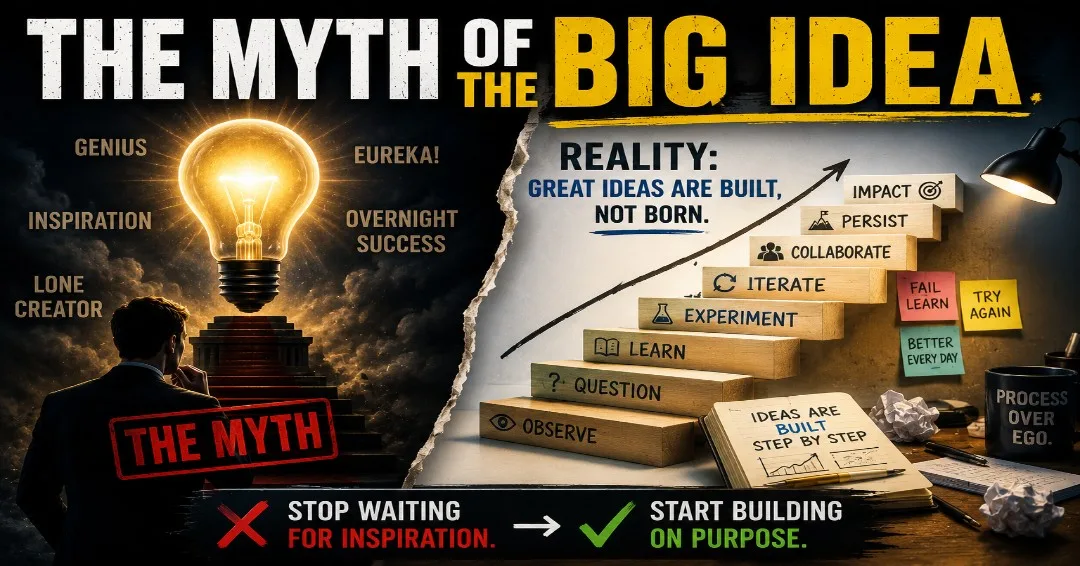
The pattern repeats often enough that it stops looking like an accident. What separates the startups that make it from the ones that don't usually isn't the cleverness of the original concept — it's the founders' willingness to notice when reality is telling them something different from their plan, and their speed in acting on it.
Why Founders Cling to the First Idea Anyway
If pivoting works so well, why do so many founders resist it? Sunk cost is part of it: months of work and a story already told to friends and investors make the original idea feel load-bearing, like abandoning it would mean abandoning the whole effort. There's also identity at stake. Many founders don't just have an idea, they are the idea in their own mind, and questioning it can feel like questioning themselves.
Some attachment is healthy — conviction is part of what gets a company through the early grind, when most evidence is ambiguous and most advice is to quit. The skill isn't having no attachment to the idea. It's knowing the difference between conviction in the mission and conviction in the specific feature set, and being willing to let go of the second while holding onto the first.
What to Actually Optimize For
If the idea itself isn't the differentiator, what is? A few things tend to matter more in practice:
Speed of learning. The founders who win are often the ones who can run the fastest loop between trying something, seeing what happens, and changing course. A mediocre idea tested in a week beats a great idea tested in six months.
Proximity to the problem. Startups that stay close to actual users, actual complaints, and actual behavior tend to find the real opportunity faster than ones that plan in a vacuum.
Willingness to be unglamorous. The version of the idea that works is often less exciting than the original pitch. Stripe is "API for payments," not some grand reinvention of finance. The unsexy, narrow, solvable version of the problem is frequently where the value actually is.
The Idea Still Matters — Just Not the Way You Think
None of this means ideas are worthless. A bad market, a problem nobody has, a solution nobody wants — these can sink a company no matter how well it's executed. But the idea's job isn't to be perfect on day one. Its job is to be a good enough starting hypothesis, one specific enough to test and loose enough to bend.
The founders who treat their first idea as a draft, not a destination, give themselves the best shot at finding the version of it that actually works.